
“The life that I have known is gone, but in its place, a strange new music plays.”
— Adapted from W.H. Auden
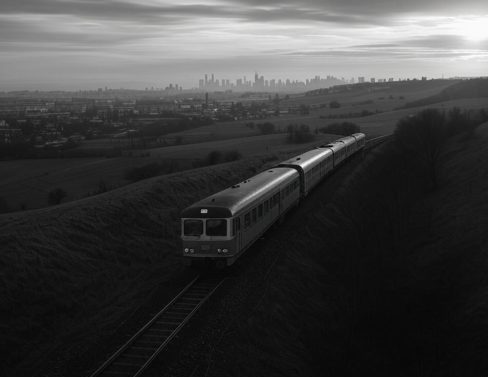
His head bobbed gently, resting against the cold windowpane of the train as it carved smooth, silver lines across the waking landscape, steel wheels humming beneath steel tracks. Dawn crept in slowly beyond the glass, a tender blush of light spilling over frost-kissed fields and sleepy suburbs, while the dim carriage cradled him in shadow. Tears traced silent paths down his cheeks, glinting like fleeting stars whenever they caught the flicker of a passing streetlamp or the soft glow of the city drawing near. He wore no earbuds, carried no tune save the one she’d left etched in his soul—her song, soft as a whisper, bright as a summer noon, smooth and gentle as the hands he could still feel in memory.
She’d been gone for some time now, slipped away over something so small he could barely summon its shape—a forgotten argument, a misplaced word. Yet the ache remained, a constant companion that swelled and ebbed between strong and stronger, a tide he couldn’t outrun. He was a different man now, carved anew by loss. Perhaps she’d see it one day, glimpse the shadow of who he’d become and fall back into the love they’d once woven so tightly. Or perhaps it would only widen the chasm she’d already crossed. He couldn’t keep pretending some enchanted twist of fate would mend them. Her voice still echoed, sharp and sterile as a surgeon’s blade, from that final day: “I want you to give up all hope.” Those words had struck deeper, colder, than anything she’d ever uttered, a cruel incantation that lingered like frost on his heart.
The train rolled on, and the world beyond the window played a silent reel of yesterdays—graveyards of sagging houses with peeling paint, rusted cars abandoned to time, faded signs of businesses that had dreamed big and died quietly. The glass was his silver screen, grey and streaked with longing. He blinked, and the last tear, nearly dry, stalled halfway down his cheek, a fragile relic of the morning’s quiet grief. A billboard loomed into view: “Marry in haste, repent at leisure,” it proclaimed in bold, opportunistic letters, some divorce attorney’s clever hook for the brokenhearted. He straightened for a fleeting moment, a wry smile tugging at his lips. Signs like these always felt like missives from above, little notes from God slipped into the mundane. As was his habit, he scanned the faces of his fellow passengers, searching for divinity in disguise—a kind eye, a knowing nod. But they stared ahead, lost in their own private worlds, offering no revelations.
He hadn’t married in haste, he reminded himself. Ten years he’d waited, even called off the wedding once when a whisper of doubt had fluttered through him. But then came the vows, the blessings that followed—children with her laugh, friends who filled their home with warmth, memories that glowed like embers in the dark. It had been worth it, hadn’t it? She was his for a season, as Ecclesiastes sang—a time to love, a time to lose—yet the scripture brought no comfort, only the dull ache of inevitability. So he leaned his head back against the pane, the cool glass a balm and a burden, and let his mind drift to another season, one where her song still played unbroken, and the train carried him not away from her, but toward.
 BB Grey--musings
Leave a comment