
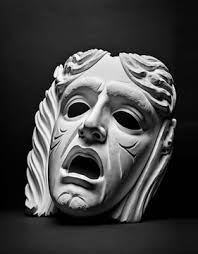
(A Greek Tragedy in Verse)
[Prologos: The Dreamer’s Lament]
O Fates, cruel weavers of the night’s design,
An ache gnaws deep, a thread malign.
A nightmare crashes, wild and unbound,
Spinning my soul to Stygian ground.
I yearn for death’s release, its silent shroud—
Yet all’s a lie, a phantom’s taunt aloud:
Pain, a game, a smileless jest,
A demon’s curse upon my breast.
[Parodos: Entrance of the Chorus]
Chorus:
Hark, O mortals, to the dream’s deceit,
A web of shadows, a doom replete.
The gods above, with pitiless gaze,
Spin mortal hearts through endless maze.
Unwind, unwind, the thread of woe,
Shhh, child of dust, let tears forgo.
[Episode I: The Voice of Salvation]
Voice (The Lover):
Hear me now, O lost one, hear my cry,
A whisper pierces through the darkened sky.
A chance I bring, to rend the dream apart,
To loose the chains that bind thy heart.
I stand before thee, steadfast, near—
In us, the truth, the found, revere.
Cast off that vision, dire and fell,
Dwell in me now, escape the spell.
Dreamer:
O voice, art thou my savior or my doom?
A kinder dream blooms soft within this gloom?
[Stasimon I: Chorus Reflects]
Chorus:
O gods, what mercy lies in love’s embrace?
A doorway gleams amidst the darkened race.
Unwind, unwind, the clock’s cruel chime,
The past—a mast through bitter brine.
Leave it, forsake it, let it fade,
A wasted hymn, a debt repaid.
[Episode II: The Struggle]
Dreamer:
The clock ticks loud, a tyrant’s reign,
The past sails fierce, a storm of pain.
Shall I release it, let it die?
The crowd’s acclaim, a hollow cry—
O love, an anchor forged in fire,
Dost thou endure beyond desire?
Voice:
Shhh, my beloved, shhh, be still,
I am thy refuge, thy iron will.
The dream dissolves, its falsehood spent,
Wake now, and mourn not what was meant.
[Stasimon II: Chorus Mourns and Hopes]
Chorus:
O fragile mortal, bound by dreams untrue,
No thou, no I, in shadows’ hue.
A silent farewell to what was spun,
A lie unravelled, a fate outrun.
Yet love persists, a flame divine,
Refusing death upon the shrine.
[Exodos: The Awakening]
Dreamer:
I see thee now—not dream, but he,
The one who holds eternity.
No longer wound, no longer torn,
From false dreams’ grasp, I am reborn.
Voice:
Shhh, my own, shhh, arise,
No tears shall stain those waking eyes.
Chorus:
Thus ends the tale, the tragic play,
The dream unwound by dawn’s first ray.
O mortals all, take heed, beware—
The gods weave dreams, but love repairs.
Summary to the Reader:
This poem, originally envisioned as a haunting, lyrical song, has been reimagined as a Greek tragedy titled “The Dream Unwound.” What began as an ethereal ballad of love, loss, and awakening—complete with verses, a chorus, and a tender refrain—has been transformed into a dramatic play in the style of ancient Greek theater. Here, the personal struggle of the Dreamer, ensnared by a deceptive nightmare, unfolds with the grandeur and gravity of a tragic myth. The song’s intimate whispers and emotional crescendos evolve into a structured dialogue between the Dreamer and a redeeming Voice, interwoven with the Chorus’s reflective odes. This adaptation employs elevated language, cosmic imagery, and the classic elements of Greek tragedy—Prologos, Parodos, Episodes, Stasima, and Exodos—to explore fate, illusion, and the triumph of love over despair, offering a cathartic journey from torment to revelation.


 BB Grey--musings
Leave a reply to Isha Garg Cancel reply