
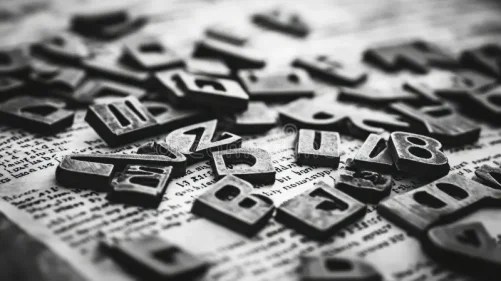
Chapter — The Alphabet That Couldn’t Sing
I tried to build words from an alphabet that was not my own. Spanish at home, English at school. The letters felt foreign, cold to the touch, like tools meant for someone else’s hands. The sentences they made were like conversations overheard through a wall—recognizable as speech, but emptied of music. I tried to force them to sing the songs I had been taught in childhood, but they stayed mute, stubborn, unwilling to bend.
The change came not in speaking but in listening. My fingers, tracing pages in the quiet of a classroom, were not just reading but writing—pressing a truth into silence. My own letters emerged then, scavenged from scraps of memory, salvaged from things I had always carried. The story didn’t spill—it unspooled, like thread drawn from some hidden spindle inside me.
The words made their own odd music. Some were muted, percussive, like wood knocking against wood beneath water. Others were wiry, tense, like a comb wrapped in paper, too tight to sing unless struck by hammers made of echoes. Echoes of a church voice—the kind that reminds you silence is the world’s preferred song for boys like me. Not the hollow, popular music everyone else seemed to know, but the ache of trying to make something my own, with a voice that cracked where it should have held.
No one teaches you this. They grade the mimicry, reward the echo. They hand you the instrument already built, the sheet music already written, and call it art. No one tells you the real art is in whittling the instrument from your own broken pieces, or hearing the score in the static between stations on a radio late at night when the house is dark.
It was a hard thing, being a boy building his own instrument in a world already shaping men. Men were expected to die simple, heavy deaths. But a boy’s death—the death of becoming something else—was fleeting, treated like weather you were expected to walk through without complaint. So I wore the face my mother needed. I stepped into the shoes of the man my father offered me. I clowned in his solemn costume. I got most of it wrong. And the regret was a cold stone in my gut: the regret of having tried at all.
It was cruel math, this crash course in Americanism, when your body was always the wrong variable. Some days I was the beaner. Other days I was the nazi. The equation shifted before I could solve it, and I was never sure which side of myself I was supposed to wreck—the one I was driving or the one bearing down on me—just to prove I belonged on the road at all.
This pain was a common coin, too worn for the bright marketplace. So I wrote by borrowed light—the glow of other exiles, other wanderers who mapped their survival by keeping some secret part of themselves intact, a number no one else could erase. For a time I found shelter in the clean clarity of books, pages that told me at least this story, this line, this truth was real. But even there, the words whispered from the margins. They were the ghosts in the machine.
And so I drifted into the final error, the most beautiful mistake: I found philosophies that used words as numbers. I began to measure the weight of a glance, the calculus of a memory, the sum of a life too fractured to balance. And I realized it was all the same thing: building, writing, singing. The song I had always, desperately, needed to sing.


 BB Grey--musings
Leave a reply to wGw Cancel reply